
Alacahöyük

Alacahöyük is a settlement site located within the boundaries of Çorum’s Alaca district and is regarded as one of the most important mounds in Anatolian archaeology. Known for its traces of the Hatti and Hittite cultures, the mound holds a special significance in the scholarly world because it offers a rich stratigraphy spanning both the prehistoric periods and the Bronze Age and beyond.
Cultural Layers
As a result of the research and excavations carried out, four cultural layers have been identified at Alacahöyük, a mound that has been continuously inhabited from the Chalcolithic Age to the present day. Covering the Chalcolithic, Early Bronze, Hittite and Phrygian periods, these layers are subdivided among themselves into 15 separate architectural strata. They are as follows:
- Chalcolithic Age: 4000-3000 BC, in strata 15-9 above the bedrock,
- Early Bronze Age: 3000-2000 BC, in strata 8-5,
- Hittite Age: 1800-1200 BC, in strata 4-2,
- Phrygian Age: from 750 BC onward, in stratum 1.
This uninterrupted stratigraphy shows that the mound was founded in a region favorable for settlement over thousands of years, advantageous in terms of its water sources and fertile soils.
Royal Tombs
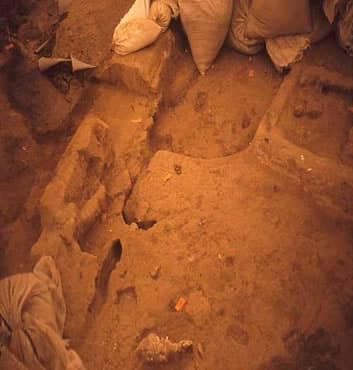
The Early Bronze Age, which followed the Chalcolithic Period and is represented by four building layers, gained importance at Alacahöyük with its 13 royal tombs. The tombs, which are claimed to belong to the 5th and 7th layers, are located in a special area of the city. In terms of their form, they can be described as unique tomb examples of Anatolia and even of the Near East. The tombs belong to adult men and women. No children or infants were buried in these tombs. Furthermore, no multiple burials were encountered in these tombs. Unlike the other tomb types in Central Anatolia, at Alacahöyük there is a uniformity in the orientation of both the tombs and the deceased.
The grave goods are the richest and most varied of those known in the Aegean and the Near East during the Early Bronze Age. Among them are sun discs, deer and bull statues, ornaments, weapons such as daggers, swords and axes, as well as artifacts made of terracotta, stone, gold, silver, bronze, copper and electrum, the likes of which have not been encountered in other cultural regions to this day. In particular, the sun discs and the deer figurines are today counted among the symbols of the Hatti civilization and of Anatolian culture in general.
The Hittite Period and the Sphinx Gate
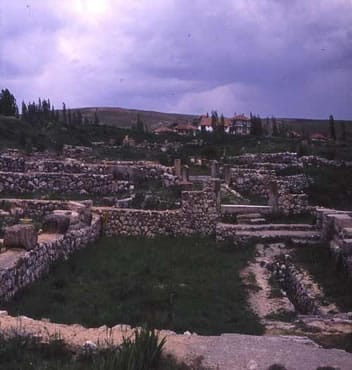
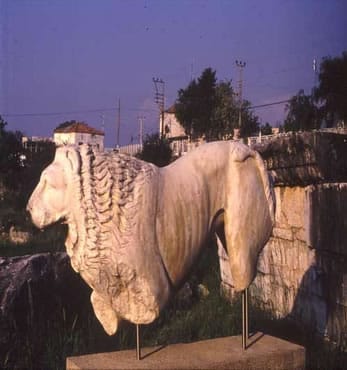
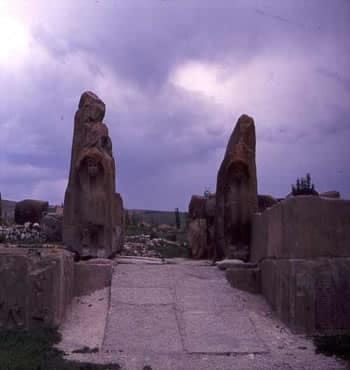
The Hittite strata, which form the currently visible part of Alacahöyük, consist of three building layers. In this period, a defensive system was created along the edge of the mound, which is roughly circular and about 250 m in diameter, and on this defensive system the existence of two main gates providing entry to the city has been identified. One of these is the Sphinx Gate in the southeast, and the other is the gate on the west of the mound. At the southeastern Sphinx Gate, which likely formed the religious gate of the city at the mound, there are two sphinxes. On the sphinx protomes, which are more than two meters high and carved onto monolithic stone lintels, the heads draw attention. The sphinxes, with their bulging bodies protruding outward, stand on separated and short legs. On the inner face of the sphinx on the eastern side, there is a double-headed eagle carrying a hare in its talons.
The reliefs found beneath the towers located to the east and west of the Sphinx Gate were worked with the bas-relief technique, and the details were rendered in a plastic manner. Almost all of the orthostats of the western tower can be viewed as a single continuous frieze. In this section, it can be seen that cult-libation subjects are depicted in the lower row and hunting scenes in the upper row. At the festival ceremonies celebrated in honor of the storm god and also known from Hittite religious texts, the king and queen, who served as high priest and priestess, are shown here in a prayer posture before a bull, and in the reliefs that follow, the other parts of the ceremony are depicted. In the reliefs on the eastern tower, there are figures praying before a seated goddess; these show that the cult ceremonies continued. After entering through the Sphinx Gate and passing the entrance complex, on the right side one can see the foundations of a large Hittite structure named the “Temple-Palace.” This structure consists of various storage rooms and other complexes.
Visiting and Surroundings
A significant portion of the artifacts found at the mound are exhibited in the collections of the Alacahöyük Museum, located right next to the site, and the Çorum Museum in the Çorum provincial center. Visitors interested in the Hittite period of the region can consider Alacahöyük together with Hattuşaş, which holds the ruins of the capital Hattuşa, and Şapinuva, one of the Hittite cult centers, along Çorum’s Hittite route.
Photos
ℹ️ This article has been enriched with additional historical context and editing over the original archive content.
Related articles

Alacahöyük Museum
Affiliated with the Çorum Museum, the Alacahöyük Museum displays finds ranging from the Chalcolithic to the Phrygian era…

Kalehisar Medrese (Behramşah Medrese)
A madrasa near Mahmudiye Village in Alaca, whose architectural style identifies it as a 13th-century Seljuk building at …

Hüseyin Gazi Madrasa
A historic madrasa located about 3 km south of the Alaca district, dating to the 13th-century Seljuk period and notable …

History of Alaca
With a history dating back to 5000 BCE, Alaca was known in antiquity as Etonia; the district was founded in 1919 as Hüse…