
Hattuşaş

Hattuşa (Hattuşaş) is an ancient city in the Boğazkale district of Çorum that served for a long time as the capital of the Hittite Empire. One of Anatolia’s most important archaeological sites, the city is known for its walls, monumental gates and temples.
History
One of the great powers of the Ancient Near East alongside Egypt, Babylon and Mitanni, the Hittites ruled over a large part of Anatolia and, at times, over Northern Syria until roughly 1200 BC.
The earliest traces of settlement go back as far as the Chalcolithic (Stone) Age (5000 BC). Uninterrupted settlement, however, began towards the end of the Early Bronze Age (3000 BC). The Hatti, the native people of the region, founded a city here and named it Hattuš. In the 20th century BC, Assyrian merchants who came from the Central Tigris region established a Karum (a trading colony) just outside the Hatti settlement. During these years the Assyrian Trade Colonies, under the control of Kaniš/Neša (today’s Kültepe near Kayseri), spread across Southeastern and Central Anatolia. This settlement, known to have been called Hattuš, was destroyed in the 1700s BC by the first Hittite Great King, King Anitta of Kuššara.
As understood from Hittite written sources, Hattuşa became the capital of the Hittites with the accession of Hattuşili I (1665–1640 BC). The city retained this status until the end of the Hittite Imperial period, that is, until the collapse around 1200 BC.
Walls and Gates
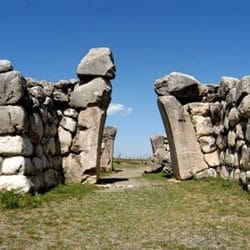
During the Hittite Imperial period, in the 14th and 13th centuries BC, the city was surrounded by a wall roughly six kilometres long. In a later building phase, a second wall was erected in front of these defences, placing the city under tighter protection. Most of the monumental city gates set into this new wall have survived to the present day in fairly intact condition. The most important of these are the Lion Gate (Aslanlı Kapı) in the southwest, with lion sculptures on its outer face, and the King’s Gate (Kral Kapı), bearing the figure of an armed god on its inner face.
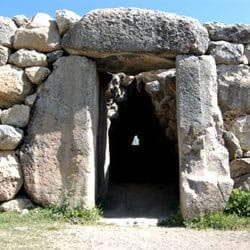
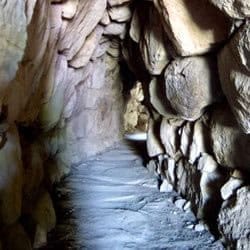
The Yer Kapı (Earth Gate) at the southern tip of the city must have had a special role. Here an earthen rampart 30 m high, 250 m long and 80 m wide was constructed. The Sphinx Gate (Sfenksli Kapı) lies at the midpoint of the city wall that runs over this rampart. Directly beneath this gate is Hattuşa’s only postern (tunnel) that can still be walked through today. Passing through the postern, which is 71 m long and 3 m high, one reaches the area outside the walls.
Palaces and Official Buildings
Most of the surviving, traceable buildings in the city date, like the walls, from the 13th century BC. At Büyükkale, where the royal buildings stood, the remains of a great palace have been uncovered, with courtyards surrounded by colonnaded galleries, residences, storage buildings and a large audience hall.
In the upper city, alongside temples, some monumental buildings reserved for official affairs have been brought to light in front of Büyükkale, where the royal palaces stood. In this part of the city are two large inscriptions, carved on stone in Luwian hieroglyphs by the last Hittite Great King Šuppiluliuma II, recounting the deeds of himself and his father Tudhaliya IV.
Temples
Hittite texts frequently speak of “the thousand gods of the Land of Hattuşa.” No doubt most of these gods were able to obtain a place of worship for themselves in the imperial capital, Hattuşa. To date, 31 buildings in the capital Hattuşa have been identified as temples. The Great Temple, Hattuşa’s largest religious building, rises as a single temple in the midst of the residences of the lower city. Because it has two cult chambers, the temple must have been dedicated to the greatest gods of the empire, the storm god and the sun goddess of Arinna.
Related Places
Visitors to Hattuşa can also see the Boğazköy Museum, where finds recovered from the city are displayed, as well as the ancient cities of Şapinuva and Alacahöyük, other important Hittite centres of the same period. For the general history of the district, see the article History of Boğazkale.
Photos
ℹ️ This article has been enriched with additional historical context and editing over the original archive content.
