Çorum Grand Mosque (Murad-ı Rabi Mosque)

The Çorum Grand Mosque (Ulu Cami) is a historic mosque located on Osmancık Street in the city center and regarded as one of the oldest places of worship in the city. Çorum is a city at the crossroads of Anatolia and an important settlement during the Seljuk and Ottoman periods; the Grand Mosque is one of the striking witnesses to this long history of settlement. Over the centuries, the building has reached its present appearance through the earthquakes, repairs, and changes in layout it has undergone.
History
Researchers have not been able to give a definite date for when the mosque was built. Nevertheless, the sources reveal that it was commissioned by Hayrettin Hazır, a freed slave of the Seljuk Sultan Alaeddin Keykubat. Based on its minbar, an extremely important work in terms of woodcraft, it has been suggested that the mosque was built toward the end of the Seljuk period, and it has been dated to the late 13th and early 14th centuries. However, whether this minbar is actually connected to the mosque is a matter of debate; it has also been suggested that the minbar was brought to the mosque at a later date. Although it is not known where the minbar was brought from, it was most likely made for another Seljuk mosque and later placed in the Çorum Grand Mosque.
The building was damaged by an earthquake during the reign of Sultan Beyazıd II. It later underwent changes during the reigns of Sultan Murad III and Sultan Selim III. According to Mimar Sinan’s work titled Tezkiret-ül Ebniye, the mosque was repaired by Mimar Sinan. After the repair carried out during the reign of Sultan Murad IV, the mosque came to be called the “Sultan Murad-ı Rabi Mosque,” and this designation became the source of the building’s second name. This was followed by a more extensive repair carried out in the 19th century.
Repairs and Changes in Layout
In its original construction, the mosque was a rectangular-plan building with an earthen roof supported by wooden columns. With the repair carried out during the reign of Sultan Murad IV, the building’s architectural plan was completely changed and converted into the multi-domed grand mosque plan type of Ottoman architecture. Evliya Çelebi noted this repair as “a structure by Mimar Sinan Ağakari within the marketplace, with a large congregation.” During this period, the prayer hall was covered with nine domes supported by columns. With the repair during the reign of Sultan Selim III, the prayer hall was converted into a square and covered with a pyramidal, conical dome resting on three columns at each corner.
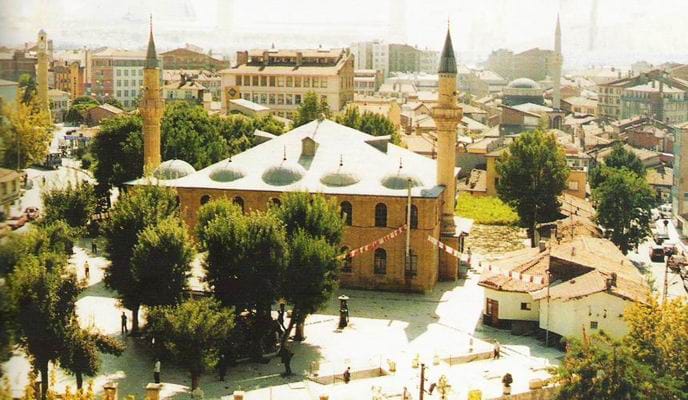
The Grand Mosque suffered great damage in the earthquakes of 1786 and 1793, after which it remained in a ruined state for eight years. The people of Çorum requested assistance from Çapanoğlu Abdülcabbarzade Süleyman Bey, the governor (mutasarrıf) of Bozok and Çankırı. Thereupon Abdülcabbarzade began repairing the mosque as a nine-domed structure, as it had been before. Abdülcabbarzade Süleyman Bey died while the repair was under way; his son Abdülfettah Bey built the wooden central single dome that survives to this day, added a single-story extension to the entrance porch (son cemaat yeri), and completed the repair in 1810.
Architecture
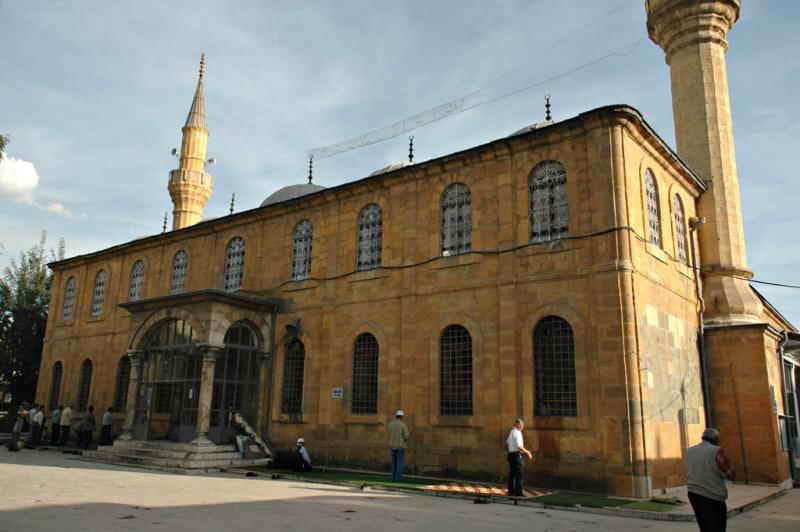
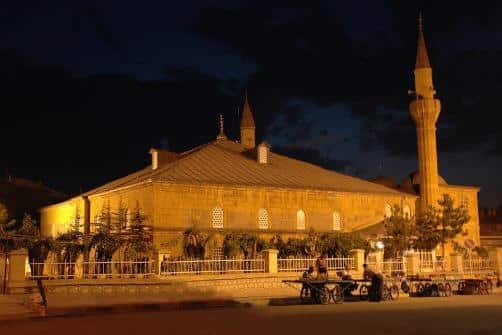
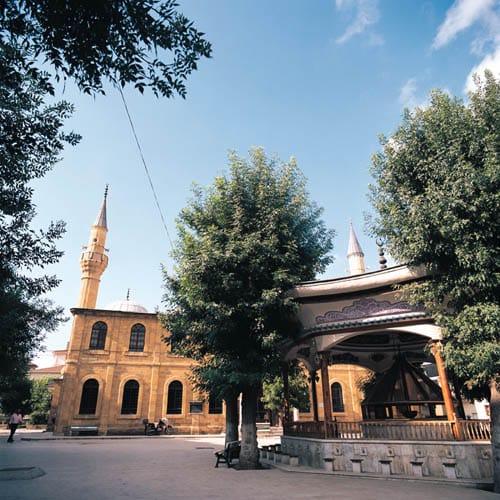
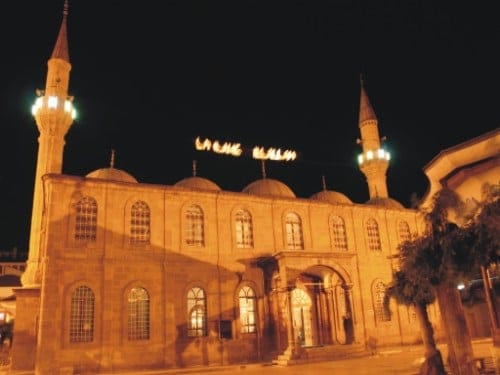
Block stones were used in the construction of the mosque; among them are stones bearing inscriptions as well as stones dating to the Roman period. This indicates that spolia (repurposed materials) brought from older buildings in the region were used in the construction. After a two-columned entrance there is an entrance porch (son cemaat yeri) with five domes. The remaining sections have wooden roofs. The mihrab is made of marble, is in the Baroque style, and is faced with marble. On either side of the entrance porch rise two minarets, each with a single balcony (şerefe).
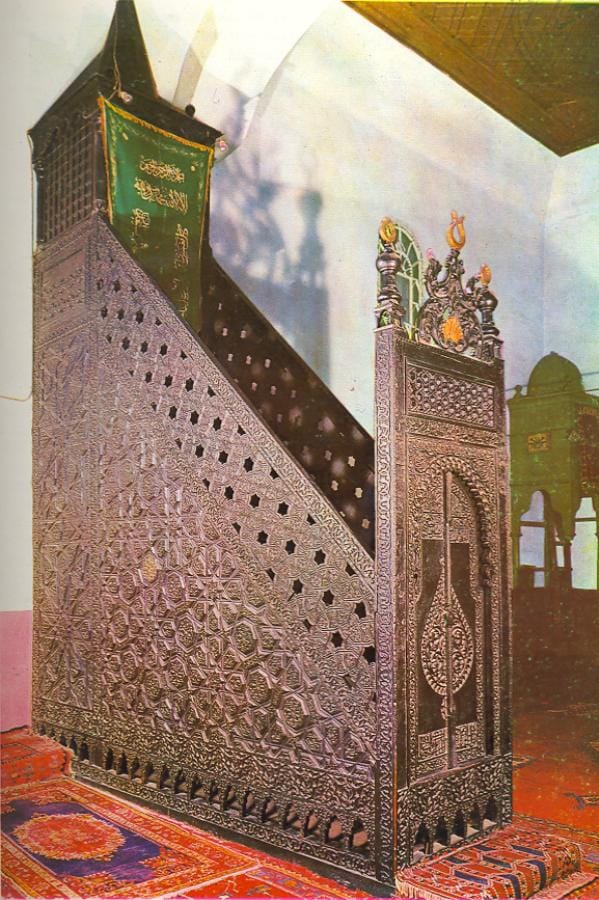
One of the most valuable elements of the building is its wooden minbar. From the inscription on the minbar, it is understood that it was made in the year 1306 (Hijri). The same inscription reveals that the minbar was commissioned by a person named Ahmet bin Davut. In addition, the names of two woodworking masters, Ankaralı bin Ebubekir and Davud bin Abdullah, are also written on the minbar. Made in the assembled kündekari technique and decorated with geometric ornament, this minbar is counted among the finest examples of Seljuk woodcraft. The interiors of the star-shaped and interlocking polygonal geometric compositions are filled with rumi motifs. A similar minbar was brought in Çorum from the Beyler Mosque, which has not survived to the present day, to the Hamid Muzaffer Paşa Mosque.
Location and Surroundings
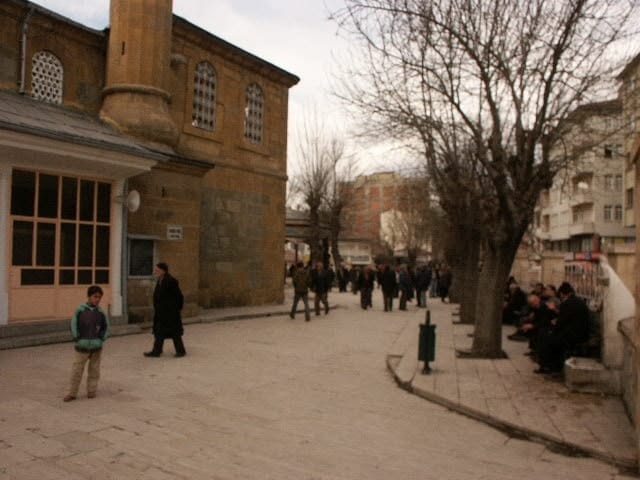
The mosque is located in the historic core of Çorum, close to the marketplace and city center. Around it lie other works that make up the city’s historic fabric. Structures sharing this same fabric, such as the Han Mosque and the Hıdırlık Mosque, along with the Çorum Museum and the Çorum Clock Tower, which shed light on the city’s past, are among the other points worth visiting in the center.
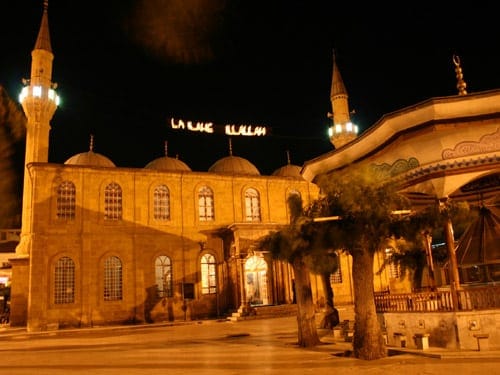
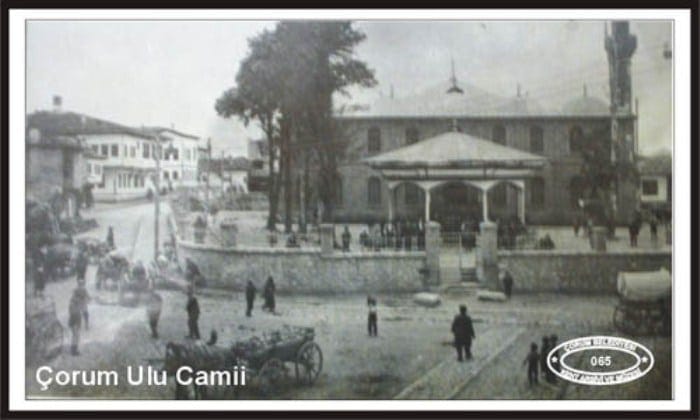
Photos
ℹ️ This article has been enriched with additional historical context and editing over the original archive content.
Related articles
Güpür Hamamı (Bathhouse)
A historic Ottoman bathhouse in central Çorum, across from the Ulu Cami, dated by its style to the 15th-16th century and…

Elvan Çelebi Mosque
A historic, square-plan mosque with a wooden roof in the village of Elvançelebi, dated 1555 and thought to have original…
Kulaksız Mosque
Located in Çorum's Yavru Turna neighborhood, the Kulaksız Mosque is an Ottoman-period building of the wooden-pillared gr…
Kubbeli Cami (Domed Mosque)
Located in the Yavru Turna neighborhood of central Çorum, this square-plan, single-domed mosque has an unknown construct…